If you want to develop a successful strategy for 2026, you can’t do so without knowing the key self-publishing trends. That’s why we’re here to tell you what awaits all of us in the upcoming year.
Keep reading to learn why you should release audiobooks, how AI can simplify your writing workflow, how to enhance your book aesthetics, and why you must review your website design.
So, let’s get down to business and dive deeper into the self-publishing trends.
Trend #1. Demand for ebooks and audiobooks continues to grow
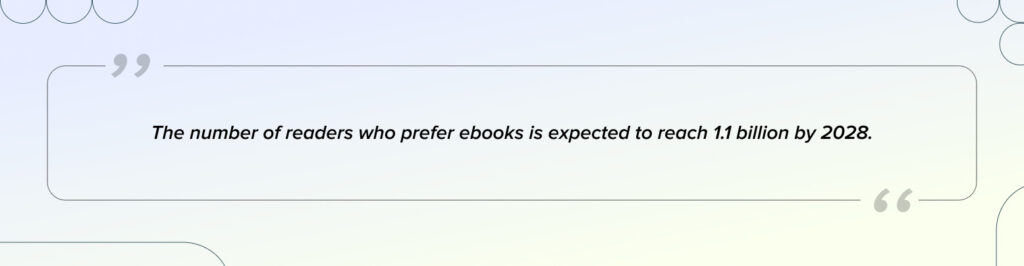
The number of readers who prefer ebooks is expected to reach 1.1 billion by 2028. This is unsurprising, as electronic versions are cheaper and accessible from any device.
This is good news for indie authors, who often have limited budgets. After all, it is cheaper to publish an ebook. Moreover, you can distribute the digital version worldwide more efficiently and faster than a physical book, which requires shipping costs at a minimum.
The audiobook market will grow by 26.4% annually over the next seven years. The voiced versions are an excellent opportunity to expand your audience. They allow people to immerse themselves in your books even when they’re busy cleaning or walking.
So, if you haven’t created an audio version of your story yet, it’s time to do so, especially since it’s easy and fast to produce it today.
Trend #2. Hardbacks and collector’s editions gain momentum
Hardcover books are becoming more common in indie publishing. In 2025, 36% of authors offer hardback editions, turning them from a “nice-to-have” into a practical option. They work especially well for collectible books, libraries, and direct sales, and are popular in genres like fantasy, sci-fi, and historical fiction. New POD hardback options have also made this format easier and more affordable to use.
Collector’s editions remain a niche choice, with only 8% of authors offering them, but they are highly strategic. Special features such as sprayed edges, foil details, or custom artwork enable authors to sell premium editions at higher margins, often through direct sales or events. These editions perform best in fan-driven genres, where readers want books that feel truly special.
Trend #3. Revenue channels for indie authors
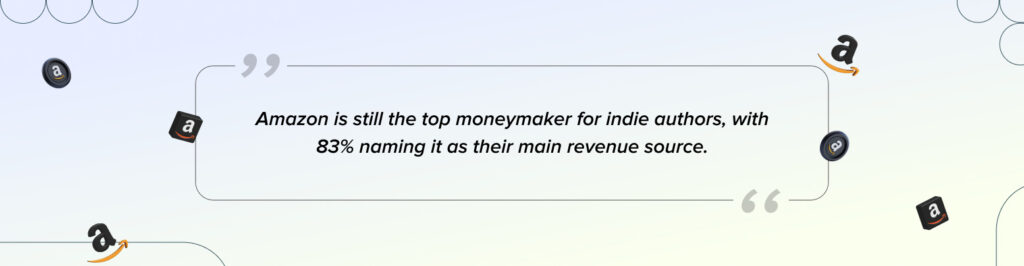
Amazon is still the top moneymaker for indie authors, with 83% naming it as their main revenue source. Kindle Unlimited plays a big role here – authors in higher-earning brackets, like $5,000–$20,000+, often make over 75% of their income here. But for those earning under $250, nearly 28% report earning nothing from Kindle Unlimited at all.
For authors looking to diversify, platforms like Apple Books (13% of authors’ second-highest revenue source), Kobo, and Barnes & Noble offer great ways to reach global readers and explore print.
Trend #4. Direct sales in self-publishing
Direct sales are gaining momentum among indie authors, but adoption rates vary widely. About 30% currently sell books directly, though 30% also plan to start within the next twelve months.
For lower-earning authors (under $250 annually), direct sales are rare, with most sticking to third-party platforms like Amazon or Kobo for their reach and simplicity. Mid-income authors ($251–$2,500) start experimenting with tools like Shopify or BookFunnel to sell directly while maintaining their presence on larger platforms.
Higher-earning authors ($10,000+) embrace a balanced strategy, using both direct sales and third-party platforms. Direct sales let them keep more profits, build stronger reader relationships, and offer perks like exclusive content or signed books.
Trend #5. Bigger catalogs drive higher income
Catalog size remains one of the strongest predictors of success in indie publishing. Authors with more published books tend to earn more.
Most authors with 1–3 books earn under $100 per month. Income starts to rise at 5–9 books, and the real jump appears at 10+ titles. Authors with 25+ books see the strongest results, with median earnings around $3,000/month and many making $5,000+.
The key reason is series. When books are connected, one reader can turn into multiple sales. Marketing works better, read-through increases, and each promotion has a bigger impact.
The takeaway is simple: building a backlist is one of the best long-term strategies for indie authors. Every new book gives readers another reason to stay in your world and helps your income grow over time. Alexa Bigwarfe also pointed it out in her book marketing webinar.
Trend #6. Romance, fantasy, and sci-fi are top genres among indie authors
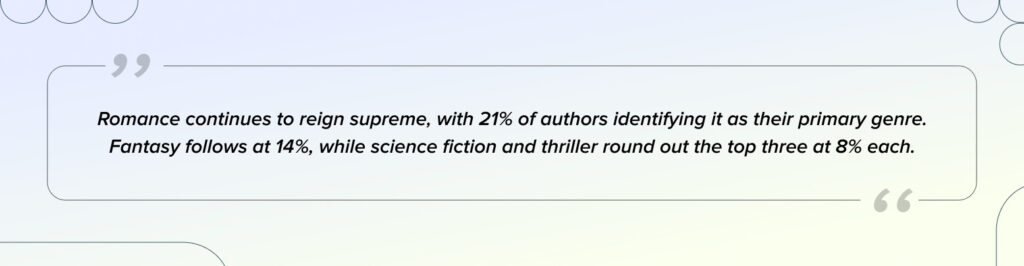
Romance continues to reign supreme in self-publishing, with 21% of authors identifying it as their primary genre. Fantasy follows at 14%, while science fiction and thriller round out the top three at 8% each. These genres are staples of the indie author community, beloved for their broad appeal and for cultivating loyal, engaged reader bases.
Several smaller yet important genres also grew in presence, including Cozy Mystery, Literary Fiction, Paranormal Romance, Children’s, Women’s Fiction, Young Adult, Horror, and Religious Fiction & Non-fiction.
What Would Your
Perfect Cover Look Like?
Get a free book cover idea that fits your story and genre.
Trend #7. Editing matters, but smart spending wins
Editing is still essential for professional indie books, but the 2025 data shows that higher spending doesn’t automatically mean higher income. Top earners almost always invest in editing, usually in the $250–$1,999 range, not $2,000+.
Authors earning $500–$10,000/month most often spend $250–$999 per book, making this the strongest “sweet spot.” In contrast, many low earners either spend nothing or overspend early without seeing results.
So, invest consistently and strategically, since good editing keeps readers engaged, improves reviews, and supports long-term growth.
Trend #8. Best marketing strategies in self-publishing
Authors overwhelmingly agree that marketing is the hardest part of indie publishing. But the data also shows which tactics actually work.
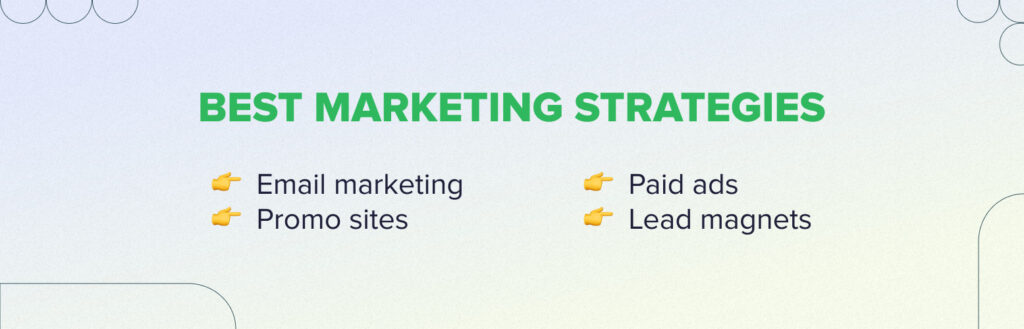
The strongest and most consistent performer is email marketing. Authors earning $10k+/month average 18,000+ subscribers, while those without a list earn about 20× less. Email lists power launches, promos, direct sales, and long-term reader relationships, without relying on algorithms.
Other top-performing tactics include promo sites (such as Freebooksy, Bargain Booksy, and BookBub) and Facebook Ads for authors who learn the system. Lead magnets are essential for list growth, while Amazon Ads and BookBub Ads can work, but are often harder to optimize and easier to overspend on. Kickstarter remains the most polarizing tactic — highly successful for some, but not consistently reliable.
Trend #9. TikTok and Reels in book promotion
Short video forms, like TikTok clips and Instagram Reels, remain a powerful marketing tool, and here is why.
As of 2025, #BookTok has had over 370 billion views on TikTok, with that number growing daily. It’s no secret that the platform helps authors who have long been overlooked become popular. For example, as happened with Lloyd Devereux Richards.
As for Instagram Reels, more than 2 billion people interact with them monthly. Thus, you must take advantage of this vast audience.
Generating book video content for TikTok and Instagram should be part of your social media strategy in 2026, if you haven’t already.

Trend #10. Accessibility for your readers
Take care of your readers with disabilities. This means that electronic and audio versions are a must. This way, readers can adjust the font size and contrast and listen to your book if traditional reading doesn’t work for them.
However, accessibility is not only about the book format but also about your website. Add to that the ability to choose a version for people with low vision or a voice search function. Reviewing your website in general for compliance with web accessibility principles would be a good idea.
Trend #11. Authors feel overwhelmed, but not alone
Now, authors are motivated and hopeful, but also tired. Marketing, changing algorithms, and platform uncertainty are common sources of fatigue, along with a sense of working alone.
At the same time, optimism remains strong. Many authors are proud of their books, seeing progress, and committed to continuing despite the challenges. And these struggles are shared.
Community still matters, but balance is key. Facebook groups remain the main hub, especially genre-focused and strategy-driven spaces. Many authors are now choosing fewer, more supportive communities to avoid burnout and protect their writing time.
Summing up the self-publishing trends
Now you’re ready and equipped to face 2026 and achieve even greater success as an indie author. Let’s summarize the upcoming self-publishing trends once again:
- Ebooks and audiobooks remain in high demand
- Hardcovers gain momentum
- Amazon is still the best revenue channel for indie authors
- Direct sales grow in popularity in self-publishing
- Romance and fantasy are expected to be the most anticipated genres
- Specialized promo sites are great for getting new readers
- TikTok and Instagram Reels can boost book sales
- Authors should make their books and websites accessible to everyone.
Which of these self-publishing trends do you like the most? Share your opinion with us in the comments.



Great little article